star rail character tier list (2026): A Player’s “Pull Smarter, Clear Faster” Guide to the Meta, Roles, and Real Team Value
If you’ve ever stared at a banner in Honkai: Star Rail with 80 pulls saved and thought, “Okay… is this character actually cracked, or am I about to get baited by hype?”—that’s exactly why people search star rail character tier list. Tier lists aren’t just for flexing “S-tier only” opinions. They shape what you pull, what you farm, what you build, and honestly… how much pain you feel in endgame modes like Memory of Chaos, Pure Fiction, and Apocalyptic Shadow (the mode that punishes “my team is almost functional” harder than anything else).
But here’s the catch: Star Rail’s meta is not static. The game changes every time a new version drops, a new limited unit arrives, an old unit gets indirectly buffed by a new support, or a new endgame rotation favors a certain damage type (Break, DoT, follow-up, AoE waveclear, etc.). That’s why you’ll see tier lists shift across versions—especially around major jumps like Version 4.0 (March 2026).
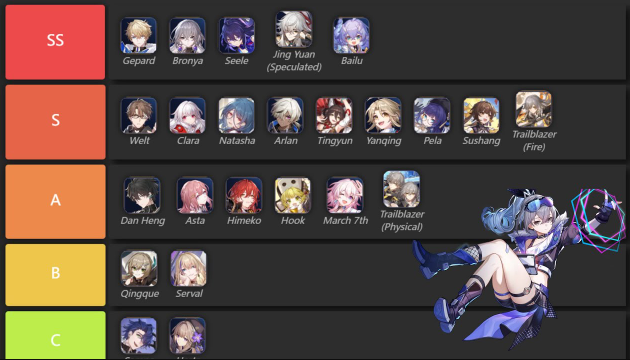
I. Introduction to the “star rail character tier list”
A. What a star rail character tier list is (and why it affects pulls and builds)
A star rail character tier list is basically a ranked snapshot of how characters perform in the game’s current environment—usually evaluated in endgame modes and common team archetypes. The big reason tier lists matter in Star Rail is that building a character isn’t cheap. Once you commit, you’re committing Trailblaze Power, relic farming, trace mats, light cone investment, and team support. If you “build everyone a little,” you end up with a roster that looks big but clears nothing comfortably.
Tier lists help you answer real questions like:
“If I can only pull 2 limited units this year, who gives the most account value?”
“Which supports make multiple teams stronger at once?”
“Which DPS are actually consistent vs rotation-dependent?”
“Which units are ‘endgame specialists’ and which are ‘everywhere’?”
B. Why the meta changes with new versions, buffs, and characters
Star Rail meta shifts for three main reasons:
New characters introduce new archetypes
Example: Break-centric teams didn’t just “happen.” They became a real meta pillar because specific DPS + specific supports made Break feel like a win condition instead of a side mechanic.Endgame rotations reward different damage profiles
Pure Fiction is basically a wave-clear / AoE / tempo check.
Memory of Chaos is a “two teams, sustained combat, boss checks” environment.
Apocalyptic Shadow is often the harshest “mechanics + optimization” test.
Indirect buffs are real
When a new Harmony support arrives, older DPS can jump tiers without changing a single number on their kit—because their best team got stronger.
C. How to use tier lists as a guide, not a rigid rule
My “tier list sanity rule”:
Tier lists are account-agnostic.
Your roster is account-specific.
So if you already own a premium support core and you’re missing a main DPS, your best pull might be a “top DPS” even if a support ranks higher globally. Meanwhile, if you have three DPS and no real sustain/support, your account will feel worse than someone with fewer DPS but a proper support backbone.
II. How Star Rail characters are tiered
A. Tier structures (S/A/B/C and SS/extra tiers)
Most modern tier lists use:
SS / T0 / “Meta-defining”: best-in-slot for multiple teams or the cornerstone of a top archetype
S: extremely strong, widely useful, often best-in-slot in at least one mode
A: strong, sometimes needs more support or is more mode-dependent
B/C/D: niche, outdated, or very investment-hungry for modest payoff
Sites like Prydwen also break tiering by mode (MoC, Pure Fiction, Apocalyptic Shadow), because “overall tier” is too vague in Star Rail.
B. Tier criteria: damage, support value, scaling, consistency
When I rank units as a player, I use five questions:
How often does this unit solve a problem? (damage checks, survivability, speed, Break windows, AoE waves)
How flexible are their teammates? (do they work with many supports, or require one specific partner?)
How hard are they to build? (relic/stat demands)
How consistent are they across rotations?
How much account value do they bring? (one team or multiple teams?)
C. Snapshot vs live-updated tier lists across 4.0 and onward
In 2026, you’ll see tier lists explicitly labeled by version—like Version 4.0 in March 2026—because that patch context matters.
A “best unit” in one version can drop half a tier simply because the endgame rotations stop favoring their damage pattern, or because a new unit offers the same job but better.
III. Overall Star Rail meta snapshot (2026)
A. Meta-defining characters (the names you keep seeing)
Across major tier list discussions and 2026 meta writeups, you’ll frequently see a core group mentioned as dominant or meta-defining—especially supports like Ruan Mei and certain top DPS choices (e.g., Firefly, Boothill, Acheron, plus high-value enablers like Robin and Aventurine).
If you want the simplest 2026 reality check:
Harmony supports are account multipliers.
Break and high-tempo comps are a major pillar.
Pure Fiction still rewards AoE and action efficiency.
Apocalyptic Shadow punishes sloppy team construction.
B. Most popular paths and element pairings
Even if you don’t obsess over Path labels, the 2026 environment heavily values:
Harmony supports that boost team output and tempo
Nihility debuff/DoT cores that scale in longer fights
High-value Sustain (Preservation/Abundance) that keeps your DPS actually alive in hard content
(And yes, teams still often revolve around a “damage engine” + “two supports” + “one sustain,” unless you’re running hyper-aggressive clears.)
C. Roles that dominate Pure Fiction, Apocalyptic Shadow, and Break teams
Pure Fiction: AoE consistency + action economy matters more than single-target nukes.
Apocalyptic Shadow: gimmicks, boss mechanics, and “can your team execute under pressure?” matter a lot.
Break teams: units that amplify Weakness Break efficiency and convert Break into real damage spikes become top-value. Ruan Mei is consistently discussed as a big enabler here.
IV. S-tier and SS-tier characters
I’m going to structure this like a player who actually clears content: by role, not by “who’s cool.”
A. SS/S-tier Supports (account multipliers)
Ruan Mei (Harmony) is still widely treated as a “meta-defining” support because she boosts Break efficiency and overall team damage flow, enabling multiple archetypes rather than just one.
Other supports that frequently appear as top-value in 2026 discussions include Robin and Sparkle (depending on team needs, SP economy, and archetype).
Player perspective takeaway:
If you’re short on premium supports, pulling a “top support” often improves two teams at once, which is basically the most valuable thing in Star Rail endgame.
B. SS/S-tier DPS (meta leaders, not “every DPS is equal”)
In the late-2025 to early-2026 meta writeups, characters like Firefly, Boothill, and Acheron are repeatedly highlighted as dominant picks (especially for endgame benchmarks like MoC).
Player perspective takeaway:
S-tier DPS aren’t just “big numbers.” They’re DPS who:
have reliable damage windows,
work with multiple supports,
and don’t collapse if one fight condition changes.
C. SS/S-tier Sustain (the reason your runs stop collapsing)
Sustain picks are often the difference between:
“I can clear” and
“I can clear consistently without resetting five times.”
Top sustain units tend to rank highly because they stabilize both MoC and boss-heavy content like Apocalyptic Shadow. Tier lists commonly separate sustain because their value is different from DPS.
Player perspective takeaway:
A top DPS with no sustain/support is just a screenshot machine. A good sustain makes your whole account feel less stressful.
V. A-tier and strong meta-holding characters
A. High-value A-tier characters in specific niches
A-tier doesn’t mean bad. In Star Rail, A-tier often means:
“excellent in one mode”
or “excellent with the right teammates”
or “slightly less universal, but still strong”
For example, Pure Fiction specialists can feel “better than S-tier” if the rotation heavily favors AoE wave clear. Meanwhile, boss-centric modes can make single-target specialists rise.
B. When A-tier can outperform S-tier
Easy examples:
In Pure Fiction, an AoE Erudition-style clearer can outperform a top single-target Hunt-style nuker.
In Apocalyptic Shadow, a unit with the right mechanic counter can outperform a “higher tier” generalist.
C. Mode-tailored examples (MoC, PF, farming)
This is why Prydwen-style tier lists are useful: they rate by mode rather than pretending “one tier list rules all.”
Player tip:
When you check a tier list, always ask: “Which mode is this tier list optimized for?”
VI. B, C, and D-tier characters
A. B-tier units with strong situational value
B-tier in Star Rail often means:
“still fine with investment,”
“good in one niche,”
or “works as a budget solution.”
You can absolutely clear endgame with B-tier units if:
you build them properly,
you understand turn order and weakness targeting,
and your supports/sustain are strong.
B. C-tier “budget” carries that age out
Many early-game carries feel amazing when your account is new, because they’re easy to build and your content difficulty is low. Later, they can drop off because endgame demands either:
higher scaling,
stronger team synergies,
or better action economy.
C. D-tier (when to build: basically never, unless you love them)
Some characters are simply outclassed or too inefficient unless they get a new synergy partner or a major indirect buff. If you love them, build them—this is a game. But don’t build them expecting “meta value.”
VII. Tier lists by rarity and investment
A. 5-star vs 4-star tier thinking
5-stars dominate ceilings, but 4-stars often dominate efficiency:
easier Eidolons,
easier to build early,
and many fill crucial support/debuff niches.
A good tier list mindset is “role coverage,” not “rarity worship.”
B. F2P and budget-friendly picks
F2P accounts win by doing two things:
Building one premium team core slowly
Using strong 4-star role-fillers to complete team templates
Tier lists can help identify which 4-stars remain relevant long-term (especially utility supports/debuffers).
C. When to “soft-lock” a 5-star vs stick with cheaper 4-stars
Soft-lock a 5-star when they:
define a whole archetype for you,
are hard to replace in your roster,
and will stay relevant across rotations.
Stick with 4-stars when:
they already fill your role needs,
your banner budget is limited,
or you need to save for a true account multiplier (usually a top Harmony support).
VIII. Path-specific star rail tier lists
A. Harmony supports ranked by utility
Harmony is the “make everyone better” path. A support like Ruan Mei is discussed as universally powerful because she enhances Break efficiency and team damage flow across many comps.
B. Destruction and DPS path breakdown
Destruction-style DPS often blend:
survivability,
consistent damage,
and sometimes self-sustain.
They tend to feel great for MoC-style content where fights aren’t just short bursts.
C. Erudition, Preservation, Nihility, Hunt, Remembrance, and others
Erudition often shines in Pure Fiction.
Hunt shines in boss-focused encounters.
Nihility can define DoT/debuff archetypes (and some are extremely meta-relevant in the right rotations).
Preservation/Abundance sustain keeps your clears consistent.
Mode-specific value matters, so path is a clue, not a verdict.
IX. Element-based character rankings
A. Best elements by “practical account value”
Elements matter because weakness matching is how you win fights efficiently. But in 2026, many teams can brute-force with strong supports—still, weakness targeting remains a huge performance boost in endgame rotations.
B. Element synergy and weakness exploitation
A good tier list player habit is:
build 2–3 “core teams,”
then widen elemental coverage gradually.
Don’t try to cover all elements at once. You’ll run out of relic sanity.
C. Examples for weekly bosses, MoC, Apocalyptic Shadow
MoC: consistency + two-team coverage.
Apocalyptic Shadow: mechanic checks and optimized execution.
X. Best team comps and meta templates
A. Top team templates you’ll keep seeing
In 2026, the most common “winning templates” look like:
Break-focused teams
Often centered around a strong Break DPS + a Break amplifier support (Ruan Mei commonly discussed here).Burst-nuke / hypercarry teams
One main DPS + double Harmony + sustain (or sustain-lite if you’re speed-clearing).DoT / Nihility engines
Debuff stacking, longer fight value, and synergy-based scaling.
B. Matching S-tier + A-tier into full comps
The biggest mistake people make is owning two S-tier DPS and then having:
no real support core,
no sustain,
no SP management plan.
A strong comp is not “4 damage dealers.” It’s “a damage engine with a support machine behind it.”
C. Popular builds (Firefly/Boothill/Break squads, Ruan Mei-centered teams)
Multiple 2026 meta discussions point to Firefly and Boothill as dominant, and Ruan Mei as a major support enabler.
Player tip:
If you pull a top Break DPS but don’t have a Break support backbone, that DPS may feel “overrated” on your account. The tier list isn’t lying—you’re just missing the ecosystem.
XI. New characters and patch-driven tier shifts
A. How new characters impact tier lists (4.0 and beyond)
As of Version 4.0 (Feb–Mar 2026), banner lineups include new and rerun characters, and the game’s limited banner cadence continues to shape who’s “worth it right now.”
New characters can:
create a new archetype,
replace an older unit’s niche,
or buff older teams simply by existing.
B. Old top picks that dropped (and why)
Usually, “drops” happen because:
their niche is replaced,
endgame rotations stop favoring them,
or their team requirements become too strict compared to newer options.
C. How to adjust your roster and budget
My pull strategy rule in a shifting meta:
prioritize supports that scale multiple teams,
then pick one or two DPS archetypes you actually enjoy,
then patch gaps (sustain, element coverage).
XII. Community and creator tier lists
A. Reddit tier makers vs “official style” tier lists
Community lists are fun and often insightful, but they’re sometimes biased toward:
0-cycle clears,
whale investment,
or personal favorites.
Meanwhile, multi-mode tier sites like Prydwen explicitly rate by endgame mode (MoC, Pure Fiction, Apocalyptic Shadow), which tends to be more useful for normal players.
B. Differences between sites/streamers/community votes
The big difference is usually:
what they consider “success” (0-cycle vs normal clear),
what investment they assume,
and which mode they prioritize.
C. How to cross-check instead of copy-pasting
My cross-check method:
Check a mode-based tier list (Prydwen style)
Check a general tier overview (Game8-style snapshots)
Compare with a creator discussion if you want context
If two out of three agree, it’s probably a solid evaluation.
XIII. F2P and pull-strategic tier list reading
A. How to read tier lists with limited 5-star spending
F2P tier list logic:
you can’t chase every “S-tier of the month.”
you need account multipliers and coverage.
B. Which characters to prioritize early vs skip
Early priorities:
one strong sustain option,
one strong support option,
one main DPS that fits your chosen archetype.
Skips:
niche specialists that only shine in one mode,
characters that require multiple premium teammates you don’t own,
banners that don’t solve a problem on your account.
C. Soft-lock targets and when to gamble
Soft-lock targets are characters that:
stay valuable for multiple versions,
have broad team compatibility,
and don’t rely on extremely specific conditions.
Harmony supports often fit this definition in 2026 discussions.
XIV. Beginner-friendly tier list breakdown
A. Best picks for new players
New players should prioritize:
characters that work at low investment,
supports/sustain that reduce frustration,
and DPS that don’t require perfect relics to function.
B. Minimum effective teams using 4-star and F2P-friendly units
A “minimum effective” team template:
one carry DPS,
one support/buffer,
one debuffer or secondary support,
one sustain.
You can clear a surprising amount of content with this if you build it correctly.
C. Safe pulls and early carries
Safe pulls are less about “highest DPS” and more about:
“this unit will still matter six months later.”
XV. FAQ and top tier-list questions
A. How often should you trust the current tier list?
Trust it as a snapshot—especially when it’s labeled by version and mode. A tier list from March 2026 (Version 4.0 context) is not identical to what was true in early 3.x.
B. Can a C-tier beat an S-tier?
Absolutely—because:
team synergy beats isolated power,
player decision-making matters,
and mode mechanics can favor niche picks.
Tier lists measure average value, not guaranteed wins.
C. How tier lists handle leaks and limited banners
A good public-facing tier list usually avoids ranking leaks as facts. For planning, use official banner info and confirmed releases. (A current banner overview for Version 4.0 is tracked by mainstream outlets.)
A star rail character tier list is useful, but only if you read it like a player with a real account and real resource limits.