Mecha Break Tier List (Feb 2026 Season 2) — A Ranked PvP Player’s No-Fluff Striker Rankings
If you’re here for a mecha break tier list, you’re probably in the exact same spot I was: you’ve got limited time, limited unlock currency, and absolutely no patience for picking a Striker that looks cool but feels like dragging a refrigerator through ranked.
Season 2 (Feb 2026) pushed the meta into a pretty clear direction: objective control wins more games than highlight reels—especially in Operation Verge, where holding space, denying pushes, and winning long fights matter way more than “I got two picks then died.” Operation Verge is also the mode where most arguments about “who’s S-tier” get settled quickly, because the mode forces you to play the map, not just the scoreboard.
what’s strong, why it’s strong, what counters what, and which Strikers are easy value vs. high-skill projects. I’m following your outline, staying player-perspective, and keeping it practical—because in ranked, “theory” doesn’t matter if your Striker can’t survive the first real team fight.
I. Tier List Methodology
A. Ranked PvP focus (Champion+), win rates, and “serious play” usage
This tier list is built around what actually shows up when players are trying to win—high-ranked PvP habits, consistent performance across matches, and the kind of picks teams lean on when they need reliability (not just one insane round). For extra sanity-checking, I also looked at mode-specific performance tracking and community discussion around Verge priority.
B. Factors: Damage output, survivability, utility, and counters
I’m ranking Strikers based on four things that decide games in Season 2:
Damage that matters (not “damage farmed into tanks,” but actual fight-winning pressure)
Survivability (self-sustain, shields, disengage tools, and “can I live while holding point?”)
Team utility (healing/shield tools, space denial, setup, burst windows, anti-dive)
Counter pressure (how easily you get shut down when the enemy drafts correctly)
C. Updated post-Season 2 patches (Feb 2026)
Season 2 balance changes moved the needle on several Strikers—support drone changes, bomb nerfs, and defender tuning are all part of why the “old” tier lists can feel off right now.
D. Mode priority: Operation Verge
I’m weighting Operation Verge the most because it’s the most “team game” mode: you’re contesting objectives, escorting/denying, and dealing with repeat engagements instead of one clean duel. Operation Verge is explicitly designed around 6v6 objectives and mission types, which tends to reward the same kinds of kits: hold, sustain, deny, and punish over-extensions.
II. S-Tier Meta-Defining Strikers
S-tier in Season 2 is simple: these Strikers either warp draft priority or force specific answers. If your team has one and the enemy doesn’t have the counter plan, the match often feels unfair.
A. Tricera (Ultra Heavy Defender) — “I live here now” objective king
Tricera is the Striker I pick when I want the match to be played on my terms. It’s the classic ultra-heavy defender problem: you don’t “kill” Tricera quickly unless your comp is built to do it, and if you ignore it, it turns the objective into a no-fun zone.
Why Tricera is S-tier (in real games):
Space ownership: Tricera’s presence changes how enemies path. People take longer routes, hesitate on pushes, and burn cooldowns early just to avoid getting stuck in a bad angle.
Sustain and staying power: Self-sustain tools (like drones/repair options depending on build) let Tricera keep holding without needing constant babysitting.
Siege and stall: In Verge, stalling is value. Even “not losing” a fight is winning if the clock is ticking and you’re still on the point.
What makes Tricera annoying (and why it wins):
It’s not flashy. It’s consistent. And consistent wins ranked.
How to play it like a menace:
Don’t chase. Your job is to anchor.
Force the enemy to come to you, then punish their commit.
If you’re rotating, rotate early—Tricera arriving late is a tragedy.
B. Welkin (Heavy Brawler) — forcefield duelist that makes backlines panic
Welkin is the reason some matches feel like you’re playing a horror game. When Welkin is strong, teams have to draft and position around the threat of getting trapped and deleted. Even when Welkin isn’t “broken,” it still creates draft pressure because its win condition is so straightforward: isolate a target, win the duel, snowball the fight.
Why Welkin is S-tier:
1v1 lockdown identity: If Welkin catches you, you don’t “outplay,” you “hope your team saves you.”
Melee burst dominance: Close-range pressure is extremely valuable in Season 2’s brawler-leaning fights.
Threat forces mistakes: The best Welkin players don’t need to land every trap. They just need to make you play scared.
There’s also active debate around Welkin balance and forcefield tuning, including discussions about cooldown and duration adjustments in recent updates and community analysis.
How to counter Welkin (baseline plan):
Don’t wander alone.
Keep peel tools ready.
Pick kite / poke options that punish the approach.
C. Stego (Ultra Heavy Attacker) — turret form “you shall not pass” bruiser
Stego is the “attacker” that plays like a defender whenever it wants. In Operation Verge, that’s disgusting in the best way: Stego can sit on the objective, soak pressure, and still pump damage.
Why Stego is S-tier:
Objective hold with threat: It doesn’t just survive—it punishes pushes.
Turret form pressure: When Stego sets up properly, the enemy either commits hard (and risks feeding) or gives up space.
Shield-heavy trading: Stego thrives in drawn-out fights where other attackers run out of gas.
Stego’s “stationary-but-terrifying” design is a recurring theme in breakdowns of its role and strengths.
Stego player mistake I see constantly:
Setting up turret mode too early in a bad lane. If you turret in the wrong place, you become a very expensive lawn ornament. Set up where the fight has to happen.
D. Aquila (Heavy Sniper) — forgiving range, consistent poke, easy value
Aquila is the Striker I recommend when someone asks, “What’s strong but won’t make me hate my life?” It has mobility tools that let it reposition and poke safely, and it punishes teams that don’t respect angles.
Why Aquila is S-tier:
High damage at safe distances: You pressure without committing.
Hover mobility: Repositioning is everything in Verge.
Simple win condition: Keep shooting, keep rotating, don’t get caught.
Aquila frequently shows up as a top pick in Verge-oriented conversations and tier discussions, largely because it delivers damage without demanding insane mechanics.
III. A-Tier Strong Versatile Picks
A-tier Strikers are the ones I call “ranked glue.” They’re strong, they’re flexible, and they become S-tier when piloted well or drafted correctly.
A. Inferno (Attacker) — anti-heavy specialist and shield bully
Inferno’s identity is pretty clear: it’s the “I’m here to melt your big guy” pick. When tanks and ultra-heavies are common, Inferno gains value because it pressures the exact pieces many comps rely on.
Some role guides describe Inferno’s shield-melting strengths and how it excels into defenders when it can get into effective range.
When Inferno feels amazing:
Enemy comp is heavy, slow, and wants to anchor. You show up and make anchoring miserable.
When Inferno feels bad:
High-mobility comps that don’t let you take favorable trades.
B. Luminae (Support) — sustain that wins games you “shouldn’t” win
Luminae is the support that makes your team feel immortal when it’s played correctly. I’ve seen so many fights where we absolutely should’ve lost, but Luminae turns it into a slow grind win because the team just… won’t… die.
Community discussions often separate supports like Luminae/Pinaka into a special category because “one good support” can define how a team functions in objective modes.
Why Luminae is A-tier (borderline S in coordinated teams):
Sustain is tempo: If you can stay on the objective longer, you win more fights by default.
Shield bypass / drone utility (matchup-dependent): The right support tools can invalidate enemy defensive play patterns.
Makes average players perform better: A good healer smooths out mistakes.
C. Pinaka (Support) — protective drones and team HP value
Pinaka is the “simple but powerful” support. In a mode like Verge, where repeated engagements happen back-to-back, any support that increases effective health and reduces downtime is automatically valuable.
There were also notable Season 2 conversations around Pinaka drone-related buffs/changes, which is part of why it’s trending up.
Pinaka in one sentence:
Not glamorous, but your team feels way less fragile.
D. Alysnes (Medium Attacker) — aggressive melee with momentum tools
Alysnes is the kind of attacker that looks “fine” until you meet someone who knows how to abuse its tempo windows. It’s not as oppressive as Welkin, but it can still swing fights by diving at the right moment and not letting the enemy reset.
Why it’s A-tier:
It’s versatile, it punishes mistakes, and it scales well with player confidence.
IV. B-Tier Situational / High-Skill
B-tier isn’t “bad.” It’s “you need the right map, comp, or hands.”
A. Hurricane (Ultra Heavy Defender) — objective control, but team reliant
Hurricane can be strong in coordinated play, especially if your team understands how to fight around it and enable its strengths. But it’s also the type of defender that can feel miserable if your team refuses to play near the objective you’re holding.
Hurricane has been discussed heavily around update changes and buffs/reworks, including defender identity and survivability adjustments.
When Hurricane works:
Your team plays together, rotates on time, and doesn’t leave you holding the bag alone.
B. Stellaris (Striker) — high ceiling, underpicked for a reason
Stellaris is the definition of “looks insane in highlight clips.” Parry timing, combo sequencing, engagement discipline—this is the kit you pick when you’re ready to grind mastery, not when you want a chill climb.
It also shows up in Verge tier discussions where some players rate it extremely high, while others keep it lower due to difficulty and consistency.
C. Panther (Medium Brawler) — weapon swap mixups, anti-melee tricks
Panther can bully melee-heavy teams if you know how to space and swap correctly. It’s not “press button win,” but it can absolutely carry fights when the enemy comp is predictable.
Panther is frequently cited as disruptive and high impact when used to remove key targets—strong, but easy to misplay.
D. Skyraider (Attacker) — frontline bombs and utility, but volatile
Skyraider is fun and can be effective, but volatility is the issue: if your bombs get nerfed or your engagement timing is off, you become inconsistent. In ranked, inconsistent equals “I lost 3 games in a row and I don’t know why.”
Skyraider has been part of balance-change conversations (including bomb tuning) in Season 2 commentary.
V. Complete Striker Rankings Table
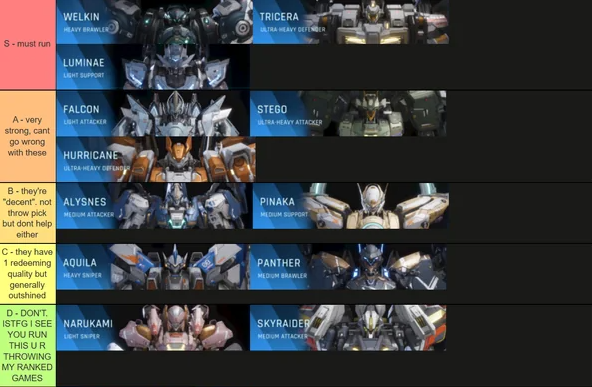
Here’s the clean “bookmark it” version of the mecha break tier list based on your outline:
| Tier | Strikers |
|---|---|
| S | Tricera, Welkin, Stego, Aquila |
| A | Inferno, Luminae, Pinaka, Alysnes |
| B | Hurricane, Stellaris, Panther, Skyraider, Falcon, Narukami, Serenith |
For reference, these Striker names match commonly listed Striker rosters.
VI. Role-Based Tier Breakdowns
Role tiers matter because a Striker can be “B-tier overall” but “A-tier in its role” depending on what your team needs.
A. Attacker
Inferno > Skyraider > Stellaris
Inferno is the consistent attacker pick into heavy comps. Skyraider is more volatile but can spike value with good timing. Stellaris has the ceiling, but you pay in consistency.
B. Defender / Tank
Tricera > Stego > Hurricane
Tricera is the anchor. Stego is the bruiser-tank hybrid that holds while dealing. Hurricane is strong when enabled.
C. Brawler / Melee
Welkin > Panther > Alysnes
Welkin is still the fear pick. Panther punishes melee and backlines with smart swaps. Alysnes is the momentum fighter.
D. Support
Luminae > Pinaka
Luminae is more fight-shaping sustain in many comps; Pinaka is reliable protective value.
E. Sniper
Aquila > Narukami
Aquila is the forgiving “win games with positioning” sniper. Narukami is often a higher-skill sniper-style pick that demands mechanics and discipline to match Aquila’s consistency.
VII. Beginner-Friendly Strikers
If you’re new, you want Strikers that give you value even when your mechanics aren’t perfect yet.
A. Aquila — simple poke, forgiving range
If you can aim decently and rotate, Aquila will win you games. It teaches spacing without forcing you into scary close-range duels.
B. Tricera — tanky, self-sustain, easy “role clarity”
Your job is simple: hold, don’t chase, don’t tilt. You’ll learn objective fundamentals fast.
C. Luminae — utility heals that swing fights
Support teaches you game sense quickly: timing, positioning, awareness. Luminae also makes teammates better (even randoms).
D. Avoid early: Stellaris
Stellaris is sick, but it’s not beginner-friendly. If you pick it too early, you’ll spend more time learning parry timing than learning the mode.
VIII. Striker Counters & Matchups
This is the part people ignore—then wonder why their “S-tier” pick got farmed.
A. Anti-Tank: Inferno plasma vs heavies
Inferno is a natural answer into heavy, shieldy comps. If the enemy drafts double anchor and thinks they’re safe, Inferno is the “nope.”
B. Anti-Melee: Aquila kites Welkin
Aquila punishes greedy melee approaches. If Welkin has to cross open space into Aquila’s sightline without support, it’s a bad time.
C. Shield bypass: Luminae drones
Support tools that bypass or mitigate shields can flip the whole feel of a fight. If the enemy relies on shield cycles, this matchup matters.
D. 1v1 kings: Welkin forcefield traps
Welkin’s threat is isolation. If you can’t prevent the trap or punish it, your backline becomes a buffet.
IX. Team Comps & Synergies
I’m going to give you comps that work in real ranked—not “perfect scrim comps,” but stuff you can actually run with randoms and still win.
A. Sustain comp: Luminae + Tricera + Inferno
Why it works:
Tricera anchors
Luminae keeps the anchor alive (and the team stable)
Inferno punishes heavy enemy pieces trying to contest point
This comp wins ugly. Ugly wins ranked.
B. Dive comp: Welkin + Skyraider + Pinaka
Why it works:
Welkin isolates
Skyraider follows with burst pressure/chaos
Pinaka keeps the dive from instantly collapsing
This is the “we start fights on purpose” comp.
C. Poke comp: Aquila + Stego turret + Stellaris
Why it works:
Aquila pokes and forces movement
Stego sets a “no-walk zone”
Stellaris punishes anyone who over-commits or tries to flank poorly
This comp feels unfair when executed cleanly.
D. Objective hold: Hurricane hold + supports
Hurricane becomes much more valuable when it isn’t alone. Give it sustain and teammates who rotate on time, and it stops feeling “team reliant” and starts feeling “team enabled.”
X. Current Meta Shifts (Season 2)
Season 2 isn’t just “numbers changed.” It changed how fights flow.
A. Welkin nerf talk: forcefield cooldown pressure
There’s ongoing discussion around Welkin’s forcefield tuning (cooldown/duration adjustments and “too oppressive” scenarios). Even when Welkin stays top-tier, the community expects nerf pressure when a kit defines too many matchups.
B. Hurricane buffs: better sustain / usefulness
Hurricane has been part of “it’s better now” conversations post-update, especially around changes that improve defender identity and staying power.
C. Shotgun/brawler vibes: close-range wins more fights
When close-range brawling gets stronger, Strikers like Welkin (and melee-capable play patterns in general) trend upward—especially in TDM-style chaos.
D. Mobility creep punishes static tanks
Even if you’re tanky, being slow can get you rotated around and ignored. This is why “anchoring” needs good positioning, not just big HP.
XI. Game Modes Tier Impact
A. Operation Verge: objective control is king
Verge rewards: anchors, sustain, and controlled aggression. That’s why Tricera/Stego/Luminae comps feel so stable here.
B. TDM: brawler/melee rises
In deathmatch chaos, Welkin can feel even stronger because fights are constant and spacing is harder.
C. Breach: snipers shine
Any mode that rewards angles and controlled space makes Aquila a problem.
D. Ranked: utility > solo carry
In solo queue ranked, the Striker that makes your random teammates harder to kill often outperforms the Striker that needs perfect follow-up.
XII. Unlock & Progression Tips
A. Battle Pass for premium Strikers
If you spend, battle pass systems are often the “least painful” value route—progress + cosmetics + unlock pacing.
B. Free rotation: prioritize S-tier trials
When S-tier is on rotation, abuse it. Treat it like a free test drive for whether the kit fits your hands.
C. Customization: weapons/mods for roles
Don’t copy “damage builds” blindly. Build for your job:
Anchors build for survive/hold
Supports build for uptime and fight reset
Snipers build for repositioning and consistent pressure
Brawlers build for commit-and-live windows
D. Level pilots for ability unlocks
Pilot progression often gates key power points. Even a great Striker feels mid if you’re missing critical ability unlocks.
XIII. High-Skill Ceiling Strikers
A. Stellaris — parry into combo chains
If you love mastery, Stellaris is worth it. Just accept the learning curve.
B. Panther — weapon swap timing
Panther becomes “unfair” when swaps are crisp and engagements are planned, not improvised.
C. Narukami — flick shot sniping
Narukami is the classic: if your aim is cracked, you’ll make it work. If not, Aquila will feel better faster.
D. Practice plan: custom games / 1v1
The fastest way to improve on high-skill Strikers is controlled reps. Grind the hardest mechanic in isolation until it’s automatic, then take it into ranked.
XIV. Patch Notes Impact Summary
A. Recent buffs: Pinaka drones
Support tuning in Season 2 is a big reason Pinaka is trending upward in competitive talk.
B. Nerfs: Skyraider bombs
Explosive pressure changes affect Skyraider’s reliability. If your main win condition got tuned down, your tier placement should change too.
C. Season 2: new mechs teased
Season transitions and teased additions always create “meta anxiety,” but the smart move is to invest in flexible cores that survive patch cycles.
D. Balance philosophy: mobility emphasis
A lot of the broader discussion around changes points toward mobility and fight flow being a design priority, which impacts how static kits feel over time.
XV. Pro Player & Community Consensus
Community consensus is messy, but it’s still useful as a temperature check.
A. Trend: Tricera near the top
In Verge-focused community tier discussions, Tricera is consistently treated as a top objective pick or anchor option.
B. Welkin debate
Welkin’s kit sparks the classic argument: “skillful duelist” vs “over-centralizing.” That debate alone tells you the pick is influential.
C. Aquila win rate talk
Mode trackers and community discussions often frame Aquila as a strong performer due to consistency and low-risk pressure.
D. Esports viability
If Mecha Break continues to push organized play, expect the meta to value comps over individual “carry Strikers,” which usually raises supports and objective controllers.
XVI. F2P Tier List Adjustments
If you’re F2P, your tier list is slightly different because accessibility and investment efficiency matter.
A. Accessible “S-tier feeling” picks: Aquila, Luminae
These two deliver strong value without demanding premium-only investment paths in many players’ experiences—and they scale well with your skill.
B. Grind events for shards
Your long-term strength comes from focused progression, not collecting everything.
C. Avoid premium-only early
If a Striker requires expensive upgrades to feel “online,” it’s a trap for early F2P accounts.
XVII. Mech Build Guides (Top 3)
These are “role-true” builds. Not perfect, but they’ll stop you from building nonsense.
A. Tricera build — max shields + repair drones + hold tools
Goal: become unmovable.
Prioritize survivability and uptime
Use repair/drone tools to reduce support dependency
Build for repeated fights, not one heroic push
Play pattern: arrive early → anchor → punish commit → rotate only when necessary.
B. Welkin build — melee weapons + forcefield uptime mods
Goal: win isolated fights and live after the kill.
Prioritize commit tools and survivability
Build for “trap → burst → escape or reset”
Don’t overbuild pure damage if it makes you die mid-commit
Play pattern: flank patiently → trap a key target → delete → disengage before the enemy collapses.
C. Aquila build — hover thrusters + poke consistency + claw upgrades
Goal: constant pressure and safe angles.
Prioritize mobility/repositioning
Build for reliable poke (not “one shot or nothing”)
Upgrade tools that help you maintain sightlines and survive dives
Play pattern: rotate with your team → take off-angles → chip and punish → never get caught alone.
XVIII. FAQ & Updates
A. How often is this updated?
Any meaningful patch (especially Season patches) can move tiers—supports and objective controllers tend to shift with balance philosophies the most.
B. Best beginner pick?
Aquila if you want damage with safety.
Tricera if you want straightforward objective value.
Luminae if you want to win more games by keeping your team alive.
C. Worst mech?
Honestly? None are truly useless. The “worst” is usually the one you picked for the wrong mode or the wrong playstyle.
D. Crossplay tiers?
In most cases, the meta logic stays consistent: objectives, sustain, and coordinated pressure tend to win regardless of platform, even if mechanical skill ceilings differ.
If you came here for a clean answer: the current mecha break tier list (Season 2, Feb 2026, Operation Verge priority) is basically this:
S-tier: Tricera, Welkin, Stego, Aquila
A-tier: Inferno, Luminae, Pinaka, Alysnes
B-tier: Hurricane, Stellaris, Panther, Skyraider, Falcon, Narukami, Serenith
But the real ranked truth is: tiers don’t win games by themselves—comps and roles do.