Brawl Stars Character Tier List (January 2026 Meta): Who to Play, Why They Work, and How to Win With Them
If you’ve played Brawl Stars for more than, like, two days, you already know the truth: the “best” brawler changes constantly, and the difference between a god-tier pick and a “why did I lock this?” pick can be one balance patch, one map rotation, or one enemy team that hard-counters you.
That’s why this brawl stars character tier list isn’t meant to be some sacred tablet you follow blindly. It’s a player-first meta guide—the kind you actually use while climbing ladder, grinding events, or sweating Power League—built around three real things that matter:
How brawlers perform in the current meta (patches, mechanics like Hypercharge, and how teams actually draft now).
How brawlers perform on real maps + modes (because “S-tier overall” means nothing if your map pool hates them this week).
How easy they are to win with (because a “broken” brawler you can’t pilot is basically a decorative skin).
Also—quick note: I’m keeping references away from Mainland China sites, as requested. The meta bits here are drawn from widely used global community/stat sources and official Supercell update notes.
Alright. Let’s cook.
I. Game Overview: What Brawl Stars Is (and Why Tier Lists Still Matter)
Brawl Stars is Supercell’s fast, chaotic, super-readable competitive shooter where 3 people can throw a match in 10 seconds—or clutch it in 1. It’s built around short matches, tight maps, and brawlers that feel wildly different from each other.
A few things make tier lists useful here even though the game is pretty balanced overall:
90+ brawlers means you’ll always have outliers—some kits just line up perfectly with the current map pool, gadget economy, and Hypercharge pacing.
Balance updates and seasonal mechanics repeatedly shift what’s “free wins” vs “why does this feel terrible.”
Mode rules change value: the best Heist brawler can be average in Bounty; the best Hot Zone controller can feel useless in open Gem Grab lanes.
And the biggest thing newer players miss:
A tier list isn’t about “best character.” It’s about “best character for the job.”
That’s why this guide keeps returning to mode context, map shape, team synergy, and execution difficulty.
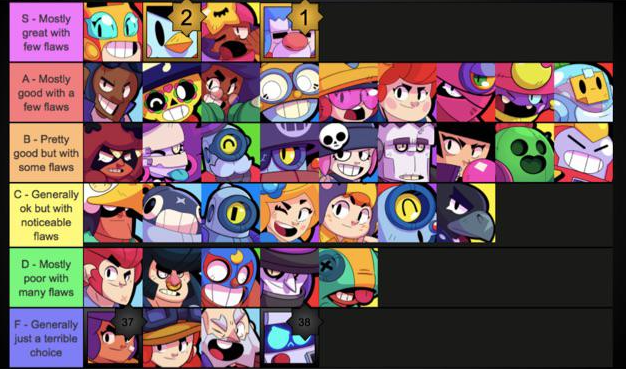
II. Tier List Classification System (How I’m Ranking These)
I’m using the common 5-tier framework you’ll see across competitive discussions:
S-Tier: Meta-defining. These brawlers force bans, force counters, or are safe first-picks because they’re hard to punish.
A-Tier: Extremely strong and consistent, but not always “warps the lobby.”
B-Tier: Solid, very playable, but more map/mode dependent or easier to punish.
C-Tier: Niche. Works only with specific maps/comps or needs too much help to justify.
D/F-Tier: Generally weak picks right now unless you’re a one-trick or the draft is perfect.
The criteria (what actually pushes a brawler up or down)
When I decide whether someone’s S vs A vs B, I’m basically asking:
Win consistency: can they win even when things get messy?
Mode coverage: do they have more than one “best” mode?
Draft pressure: do they force bans or force counterpicks?
Synergy value: do they make teammates better (or just do damage)?
Execution barrier: how hard is it to get value under real pressure?
Patch & mechanic alignment: are they favored by current balance direction and pacing?
III. S-Tier Brawlers: Meta-Defining Powerhouses (The Ones You Feel in Every Match)
Let’s talk about the brawlers that tend to feel like they’re playing a slightly different game than everyone else—either because they pressure huge space, delete people too fast, or bring utility that rewrites the fight.
1) Lumi (Artillery / Pressure)
Lumi’s vibe is simple: she makes areas unlivable. If you’ve ever tried to hold a lane while Lumi is doing her “hit you on the way out and on the way back” thing, you know what I mean.
Why Lumi is S-tier right now
Double-hit threat changes how enemies move. People can dodge a normal projectile. Dodging something that punishes your dodge path is harder.
She’s a team mode bully: on objective modes, “space control” often matters more than raw K/D.
She punishes stacked teams and bad positioning, which… yeah, that’s ladder.
Best modes
Hot Zone (she controls entry angles)
Gem Grab (she turns mid into a no-fun zone)
Brawl Ball (she’s nasty on choke maps)
How to play her without throwing
Don’t chase kills. Choke the lane and make enemies waste time rerouting.
If your team already has a controller, you can play more “finisher,” but if not, you’re basically the map’s weather system: constant pressure.
2) Hank (Tank / Frontline Disruptor)
Hank is the kind of brawler where you look at the enemy comp and go: “Do we have enough anti-tank?” If the answer is no, Hank turns into a rolling disaster.
Why Hank is S-tier
He creates unstoppable push windows when teammates follow up.
His durability forces enemies to spend ammo/time on him, which lets your damage dealers take space.
On certain maps, Hank basically says, “This lane is mine now,” and you have to negotiate.
Best modes
Brawl Ball (classic tank value)
Hot Zone (standing power is king)
Some Gem Grab maps where the lanes are tight
The mistake people make
They play Hank like a solo carry. He’s not. Hank is a permission slip for your team to move forward. If nobody follows, you’re just a big target.
3) Angelo (Damage Dealer / Versatile Midrange)
Angelo’s strength is that he doesn’t feel “locked” into one job. You can lane with him, rotate with him, and he’s rarely useless.
Why Angelo is S-tier
He’s a safe pick: not many matchups completely ruin him.
He fits a ton of comps—poke comps, balanced comps, even semi-aggro comps depending on map.
In ladder, “safe picks” win more than “perfect picks” because your teammates aren’t always cooperating.
Best modes
Gem Grab
Bounty
Knockout style maps (where consistency matters)
How to get more value
Don’t tunnel on damage. Play him like a mid who wins positioning and turns advantages into picks.
4) Carl (Boomerang / Tempo DPS)
Carl is one of those brawlers that always sneaks back into S-tier when the meta rewards reliable damage + mobility + control gadgets.
Why Carl is S-tier
His damage is consistent, not “hope I hit the perfect shot.”
He controls lanes with angles, and angles win games.
He’s a nightmare for teams that rely on predictable movement.
Best modes
Heist (depending on map)
Gem Grab
Brawl Ball (if you have the right comp)
Player advice
Carl is strongest when you treat him like a tempo brawler: win lane, rotate, snowball. If you sit still, you’re wasting his kit.
5) Chester (Legendary Chaos / High Skill Ceiling)
Chester is “high risk, high reward” but in a way that makes him terrifying when mastered.
Why Chester is S-tier
He can adapt mid-match in ways most brawlers can’t.
He forces enemies to respect unpredictable swing moments.
In coordinated play, he’s scary; in ladder, he’s even scarier because people don’t track his threat windows correctly.
The catch
Chester will betray you if you don’t practice him. You can’t just “pick him for tier.”
Best modes
Knockout / Bounty (pick potential)
Brawl Ball (burst swing plays)
6) Frank (Tank/Heavy)
Frank in S-tier always feels like a meme until you’re the one getting pinned into a corner by a coordinated team.
Why Frank is S-tier
Massive HP changes fights.
When Frank gets momentum, he creates “you don’t get to play” moments.
He thrives when your team drafts around him (support, control, follow-up).
Best modes
Brawl Ball
Hot Zone
7) Bibi (Close-Range Bruiser)
Bibi in the right hands is like a crash course in “spacing is everything.”
Why Bibi is S-tier
She wins skirmishes through movement pressure.
She punishes teams that can’t kite properly.
She thrives in ball/objective modes.
Best modes
Brawl Ball
Hot Zone
8) Bea (Marksman / Charged Shot Threat)
Bea is the kind of brawler that makes the enemy team play scared—because one charged shot flips the lane.
Why Bea is S-tier
Long-range pressure, high burst windows
Great into midrange comps
Strong on open maps where positioning matters
Best modes
Bounty
Knockout
Open Gem Grab maps
9) Kenji (Assassin / Sustain)
Kenji is real, and he’s been referenced in official patch notes, including bug fixes tied to his animations/mechanics, so yes—he’s not some rumor brawler.
Why Kenji is S-tier
He plays like an assassin who can stay after the first kill attempt.
Built-in sustain means he’s less “all-in and die” than classic assassins.
In a meta where people rely on small mistakes, Kenji farms mistakes.
Best modes
Brawl Ball (if your comp can open lanes)
Gem Grab (as a threat/pressure pick)
Certain Heist maps if he can reach value targets safely
10) Spike (Legendary Consistency)
Spike is the evergreen answer to “I don’t know what to pick but I want to win.”
Why Spike is S-tier
Solid into tanks, solid into grouped teams, solid into objectives.
Doesn’t require weird conditions to be useful.
Always has playmaking value even when behind.
Best modes
Basically everything, but especially:
Hot Zone
Gem Grab
Brawl Ball
IV. A-Tier Brawlers: Strong Specialists That Win Games (If You Use Them Right)
A-tier is where the “smart picks” live—brawlers that might not be universally oppressive, but they give you reliable win conditions.
Jae-Yong (Support)
Jae-Yong is the classic “my team wins because we move better and stay alive longer” brawler.
Why he’s A-tier
Utility supports scale with team quality.
Movement/heal value changes fights in objective modes.
Best modes
Gem Grab
Brawl Ball
Hot Zone
Finx (Controller)
Finx is all about turning parts of the map into “your team wins here.”
Why he’s A-tier
Area control + team speed utility is basically meta glue.
He’s especially good when your team wants to force fights on an objective.
Best modes
Hot Zone
Gem Grab
Ollie (Control/CC)
Ollie’s value comes from his ability to create punish windows where the enemy just… can’t move correctly.
Why he’s A-tier
CC is always relevant.
Great into teams that depend on clean movement patterns.
Best modes
Brawl Ball
Hot Zone
Meeple (Auto-Aim Damage)
Meeple is one of those brawlers that can look “too easy,” but that’s kind of the point: easy value is strong value.
Why he’s A-tier
Consistency in ladder is underrated.
If you’re not missing shots, you’re winning more fights.
Best modes
Heist
Gem Grab
Certain Brawl Ball maps
Tara (Control / Teamfight Swing)
Tara is the “one super and the game flips” brawler.
Why she’s A-tier
Pick potential and teamfight swings
Great when enemies clump or rely on narrow lanes
Best modes
Brawl Ball
Gem Grab
Nita (Summoner / Pressure)
Nita’s bear is basically a fourth teammate when used correctly.
Why she’s A-tier
Great at forcing ammo usage
Strong into teams that struggle to clear summons quickly
Best modes
Heist
Hot Zone
Jessie (Turret Support)
Jessie is the “win-by-structure” brawler. Some maps make her feel illegal.
Best modes
Heist
Hot Zone
El Primo (Tank)
Primo is A-tier when the map and comp let him reach people.
Best modes
Brawl Ball
Certain Hot Zone maps
V. Mode-Specific Tier Priorities (Because “Overall Tier” Lies to You)
Here’s the most practical thing you can take from any brawl stars character tier list:
Pick for the mode first, then for the map, then for comfort.
Also, daily/rotating events matter. Brawlify’s live event/map rotation pages are useful for seeing what’s actually in rotation right now.
Gem Grab
You want lane stability + mid control + a way to protect gems
Controllers and consistent ranged pressure shine
Common priorities
Controllers (space denial)
Safe midrange damage
Anti-dive tools
Brawl Ball
You want push power, CC, and goal threat
Tanks and bruisers gain value, but only if your comp supports them
Common priorities
Tanks + support cores
Knockback/CC tools
Burst finishers
Heist
You want safe damage and structure pressure
Turrets, consistent DPS, and map control win
Bounty / Knockout
You want range, discipline, and punish
Burst marksmen and safe poke dominate
Hot Zone
You want area denial
Controllers and tanks with sustain shine
Power League
This is the “real” tier list mode, because draft and counters matter most.
The best brawler isn’t always the best pick; sometimes it’s the best last pick.
VI. Rarity Impact & Stat Scaling (The “Paywall” Myth)
Yes, rarity affects access, and higher rarity brawlers often have more loaded kits. But Brawl Stars isn’t built like a typical “SSR vs SR” gacha.
What matters more is:
Kit fit
Gadget/star power choice
Hypercharge timing
Your ability to play the role your team needs
That’s also why Supercell repeatedly states they keep tuning the meta and adding balance levers.
VII. Roles & Team Composition (How to Stop Drafting Like a Randomizer)
Think of most teams as needing three jobs covered:
Space control (controller/artillery/tank)
Reliable damage (DPS/marksman)
Utility or disruption (support/assassin/CC)
If your team drafts three “damage dealers” with no control, you’ll lose to any team that can hold a zone.
If your team drafts three tanks with no damage, you’ll never finish fights before you get shredded.
The most “ladder-proof” comp style
One control
One consistent damage
One flex (assassin or support depending on map)
And yes, synergy beats tier ranking. A well-built comp with A/B tier brawlers beats three S-tier brawlers drafted with zero plan.
VIII. Hypercharge, Gadgets, and Star Powers (The Real Power Layer)
A lot of tier list changes aren’t because the base brawler got stronger. It’s because:
A gadget got buffed
A star power became the default
Hypercharge pacing made a brawler’s “win condition” arrive earlier
The practical advice:
Don’t just max a brawler—learn the loadout that matches the mode.
If you don’t know which loadout is correct, choose the one that improves:
consistency (hit rate, survivability, control), not greed (big highlights that only happen when you’re already winning).
IX. Patch Volatility: Why Today’s S-Tier Can Be Tomorrow’s “Meh”
Supercell updates repeatedly shift the meta and explicitly talks about watching how the meta shapes and then fine-tuning.
So here’s the honest truth as a player:
Tier lists expire fast
Your best investment is a small pool of brawlers you truly know
When your main gets nerfed, don’t panic—learn a backup with a similar role
If you do that, you’ll climb even if the meta changes every couple weeks.
X. Progression & Resource Allocation (How Not to Brick Your Account)
Early game (low trophies)
Don’t spread resources across 20 brawlers.
Pick 1–3 brawlers you enjoy and level them enough to feel smooth.
Consistency > variety.
Mid game
Build a pool of 5–8 brawlers that covers different modes:
one tank/bruiser
one controller
one marksman
one assassin/flex
one comfort pick
Endgame
Drafting matters more.
Map knowledge matters more.
And your mental matters more than anything (because tilt is the real final boss).
XI. FAQ (Real Questions Players Actually Ask)
“Who’s the best brawler to start with?”
Start with someone consistent:
Spike (safe all-around)
Carl (reliable damage/tempo)
Jessie (if you’re playing Heist/Hot Zone a lot)
If you’re brand new, avoid the super “mechanics-heavy” picks until you understand spacing.
“Should I follow tier lists religiously?”
No. Tier lists are a starting point, not a replacement for game sense.
“How often does the meta change?”
Frequently—balance direction and adjustments are an ongoing thing.
“Can C-tier brawlers reach high trophies?”
Yes. If you’re better than your opponents and you understand your role, you can win with almost anything. The tier list mostly tells you what requires less effort to win.
“Do I need S-tier brawlers to be competitive?”
They help, but a bad player on S-tier still loses to a good player on a comfort pick.
Here’s the big takeaway from this brawl stars character tier list:
S-tier brawlers (like Lumi, Hank, Angelo, Carl, Spike, and strong assassins like Kenji) are powerful because they either control space, force mistakes, or stay useful in most modes.
A-tier brawlers win constantly when you draft them for the right job (Jae-Yong, Finx, Tara, Jessie, Nita—these are “plan” brawlers, not “highlight reel” brawlers).
Tier lists change, sometimes fast, and the best long-term climbing strategy is:
master a small pool
draft for mode/map
stay flexible when patches hit
If you want the most practical “do this today” advice:
For ladder: pick consistent value (Spike/Carl-type brawlers) unless you’re confident on a high-ceiling assassin.
For objective modes: prioritize control over raw damage.
For Power League: prioritize draft logic over tier ranking.
And most importantly: play brawlers you actually enjoy. The fastest way to become good is to play enough matches to build instincts, and you won’t do that if you hate your pick.
If you want, I can also rewrite this into a “quick-pick cheat sheet” version (per mode + map type) you can paste into your notes while you queue.