Brawl Stars Tier List (2026 Meta): The “Pick This, Not That” Guide From a Player Who’s Tired of Losing Drafts
If you’ve played Brawl Stars for more than, like, three days, you already know the truth: the game is pretty balanced… right up until you run into that one brawler on that one map and suddenly it feels like you’re playing dodgeball against a professional baseball pitcher.
That’s why a brawl stars tier list is still useful even if you’re not a sweaty Power League demon. It’s not about “only play S-tier or uninstall.” It’s about saving you time, trophies, and sanity by answering questions like:
“Who can I main without getting bullied every match?”
“Which brawlers are actually worth my coins and power points?”
“Why do I feel unstoppable in Hot Zone but useless in Heist?”
And here’s the big thing people miss: there isn’t one single meta. There’s a Brawl Ball meta, a Gem Grab meta, a Heist meta, a Showdown meta, and the “my random teammates just walked into mid and died” meta. So I’m going to treat this like an actual player guide: practical, mode-aware, and honest about what matters at real ranks—not just perfect-pro scrims.
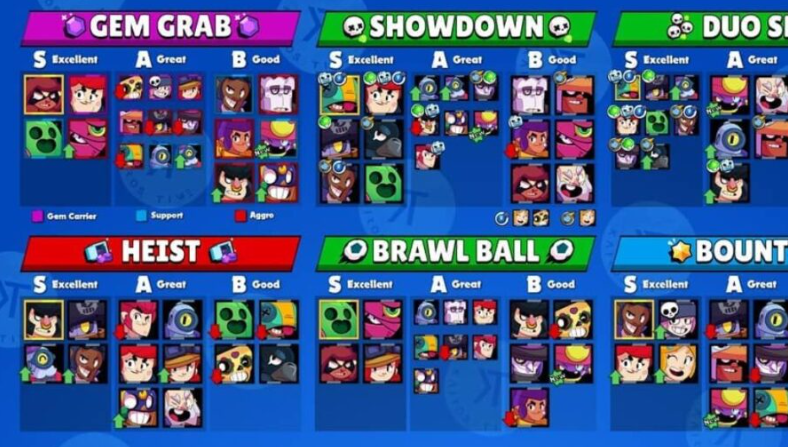
I. Introduction to the Brawl Stars Tier List
A. Overview of Brawl Stars as a competitive mobile game
Brawl Stars is basically “fast tactical chaos.” Short matches, constant map rotations, and brawlers that can feel completely different depending on:
Map layout (open lanes vs. bushy choke points)
Mode win condition (control vs. damage vs. survival)
Team comps (triple squishy vs. tank + support vs. control stack)
So when someone says “X is broken,” what they often mean is:
“X is broken in the mode and map I keep queuing into.”
B. Importance of tier lists in the current meta
A tier list is like a shortcut around months of trial-and-error. It helps you:
Spend resources smarter (max the right brawlers first)
Pick safer mains (brawlers that stay good across patches)
Understand what you’re losing to (so you can counter it)
C. How this guide is structured and updated
I’m going to do three things:
Explain the tier system in a way that makes sense for real gameplay.
Give a practical overall meta view (with a huge caveat: mode matters).
Break down best picks by mode, roles, and beginner-friendliness.
II. Tier System Explained
A. Tier definitions: S, A, B, C, and D-tier classifications
Here’s the player translation:
S-Tier: If you can play them decently, you’ll feel unfair. They either dominate a mode, break map rules, or punish mistakes brutally.
A-Tier: Strong, reliable, and usually not hard-countered into uselessness. Great mains.
B-Tier: Solid, but needs the right map, comp, or matchup. One-trickable if you love them.
C-Tier: Works if you’re better than the lobby or the map is perfect… otherwise you’ll feel the struggle.
D-Tier: You can win, but you’re choosing pain. Usually outdated kits, bad matchups, or too many counters.
B. Criteria for rankings: win rate, pick rate, and meta score
When I say “meta,” I’m looking at the stuff that actually changes outcomes:
Consistency: Can this brawler function without perfect conditions?
Pressure: Can they force space, deny lanes, or secure objectives?
Safety: Do they have escape tools, range, sustain, or control?
Mode fit: Do their tools match the win condition?
Patch impact: Did the latest update give them a new power spike?
C. How balance patches and seasonal changes affect rankings
This is the part that makes tier lists “temporary truth.”
Example: Update 65 (Buffies) introduced a system that buffs Gadgets/Star Powers/Hypercharges for specific brawlers—Colt, Shelly, Spike, Mortis, Frank, and Emz were in the first wave.
That’s not a tiny tweak. That’s the kind of change that can push a brawler up a whole tier because:
Their weak points get covered
Their power windows get bigger
Their “outplay moments” happen more often
So if you ever wondered why a classic brawler suddenly feels cracked again—yeah, that’s usually why.
III. Top Meta Brawlers (S-Tier Characters)
Let’s be real: S-tier depends on mode. A “best overall brawler” is usually someone who:
performs across multiple modes, or
is so oppressive in one mode that they’re a must-build anyway.
The “Across Modes” S-tier mindset
If you want a safe S-tier investment, you’re looking for brawlers that:
Don’t get deleted just for stepping into mid
Have control tools (pushback, zone denial, wall pressure)
Can either start fights or punish starts
Current S-tier examples by mode (what players are actually using)
Brawl Ball (All Maps)
Right now, Mortis and Cordelius show up as S-tier for Brawl Ball in the “all maps” tier snapshot.
This makes sense in real matches:
Mortis in Brawl Ball is basically: “One mistake and your backline disappears.”
He thrives because Brawl Ball forces close-range chaos and awkward positioning. And with Update 65 highlighting Mortis as a Buffies brawler, it’s not surprising he’s sitting pretty in modes where momentum matters.Cordelius is the kind of brawler that turns fights into unfair 1v1s. In a mode where winning one duel often equals a goal, that’s disgusting value.
Gem Grab (All Maps)
On the Gem Grab snapshot, Emz and Tara appear as S-tier picks.
Player logic here is simple:
Gem Grab is about mid control and teamfight resets
Emz punishes stacked approaches and controls lanes with pressure
Tara’s super can flip the entire game with one pull
Also worth noting: Emz is explicitly part of the Update 65 Buffies wave. If you’re investing long-term, that’s a signal the devs are actively tuning her power ecosystem, not ignoring her.
Hot Zone (All Maps)
Hot Zone has a very “stand here and suffer” win condition. So it’s no shock the S-tier list is stacked with control monsters like Amber, Lou, Finx, Squeak, Hank, Emz, R-T, and Max showing at the top tier snapshot for the mode.
Hot Zone rewards:
area denial (Squeak)
constant pressure (Amber)
slow/control lockdown (Lou)
tempo and team movement (Max)
If you’re trying to climb efficiently, Hot Zone is one of those modes where playing the right control brawler feels like you’re playing a different game than the enemy.
IV. Strong and Versatile Brawlers (A-Tier Characters)
A-tier is where most smart players live. Why? Because A-tier brawlers are:
strong without being gimmicky
less likely to get hard-nerfed instantly
easier to slot into random comps
A-tier examples with “real ladder value”
Frank (A-tier impact, plus patch attention)
Frank is one of those brawlers who alternates between “free win” and “free super farm” depending on the patch cycle and counters. But he’s also included in Update 65’s Buffies list.
That matters because when a brawler like Frank gets system-level attention, it usually means:
he won’t stay irrelevant for long
his build options get deeper
he becomes more consistent outside of perfect matchups
Emz (sometimes S, sometimes A—still a top investment)
Even when she isn’t S-tier in every mode, Emz is one of those “I can always do my job” picks. In modes where teams clump, her value spikes hard. And again—Buffies wave brawler.
V. Viable Mid-Tier Brawlers (B-Tier Characters)
B-tier is the land of:
map specialists
brawlers that feel amazing when conditions are right
“I main this and I don’t care” players (respect)
If you’re a B-tier main, your job is basically:
learn the maps that love you
dodge the matchups that delete you
become so good at your spacing that tier lists stop mattering
A B-tier brawler mastered is often stronger than an S-tier brawler played badly. Seriously.
VI. Average and Situational Brawlers (C-Tier Characters)
C-tier brawlers usually fall into one of these buckets:
Their kit is fine, but the meta punishes them
They need too much setup for too little reward
They get countered by common picks
And here’s the painful truth: C-tier is where you start feeling “I did everything right and still lost” more often, because the margin for error gets tiny.
A funny example: some brawlers can look “fine” overall but drop hard in certain modes. For instance, the Brawl Ball snapshot mentions Lumi sitting down in C-tier there.
That doesn’t mean Lumi is unplayable—it means in that specific mode context, other brawlers are doing her job with less risk.
VII. Weak and Underperforming Brawlers (D-Tier Characters)
D-tier is basically:
outdated tools
too many bad matchups
not enough payoff for the effort
If you love a D-tier brawler, here’s the move:
play them in modes/maps where their weakness is less punished
build comps that patch their problems (shields/heals/control)
accept you’re signing up for “hard mode” and treat it like a flex
VIII. Brawler Roles and Archetypes
Instead of memorizing 90+ brawlers, I think in roles. It makes drafting and improvement way easier.
A. Tanks
Tanks want:
cover
teammates who can follow up
matchups without constant knockback and shred
B. Assassins
Assassins want:
angles
isolate targets
punish bad spacing
Brawl Ball is often assassin-friendly, which helps explain why picks like Mortis thrive there.
C. Marksmen
Marksmen want:
open lanes
vision control
protection from dives
They’re often mode-dependent and map-dependent, but on the right layout they feel like free damage.
D. Support and controllers
Controllers win games by making the enemy miserable:
zones you can’t enter
slows you can’t dodge
pressure you can’t outheal
Hot Zone is basically a controller playground, and the top tier snapshot reflects that heavily.
IX. Best Brawlers by Game Mode
This is where tier lists actually become useful.
A. Solo Showdown
Solo is its own weird universe. You’re playing:
bush mind games
third-party survival
“why are 6 people teaming” psychology
Your best picks here often aren’t the same as 3v3 kings, because survivability and escape matter more than clean teamfight value.
B. Brawl Ball
Brawl Ball rewards:
momentum
picks that convert into goals
brawlers who can force chaos on demand
Current “all maps” top tier includes Mortis and Cordelius as S-tier.
If you’re climbing, you can build your whole account around having at least one strong Brawl Ball carry.
C. Gem Grab
Gem Grab rewards:
mid control
safe retreats
teamfight swing tools
The snapshot shows Emz and Tara as S-tier picks right now.
D. Hot Zone
Hot Zone rewards:
area denial
control stacking
sustained pressure
S-tier includes control-heavy monsters like Amber, Lou, Finx, Squeak, Hank, Emz, R-T, and Max in the current all-maps snapshot.
X. Beginner-Friendly Brawlers
If you’re newer (or you just want easy trophy gains without sweating), your best friends are brawlers that:
don’t rely on perfect aim
survive mistakes
still contribute even when behind
And honestly, patch attention matters here too. Update 65’s Buffies wave includes Shelly and Colt, two brawlers that beginners often already have and want to invest in.
That’s great news for new players because it increases the chance that early investments stay relevant.
XI. Character Rarity and Acquisition
Rarity affects:
how soon you can unlock a brawler
how long it takes to build a roster for draft modes
sometimes how “complex” the kit is
But it does not guarantee tier placement. There are always high-rarity brawlers that feel mid, and classic brawlers that become meta again with the right system changes (hello, Buffies).
XII. Building and Leveling Priority
If you want the simplest, smartest upgrade plan:
Pick one main mode you play the most (Brawl Ball / Hot Zone / Gem Grab).
Max 1–2 brawlers that are top-tier in that mode (or at least A-tier).
Build one backup brawler for when your main gets banned/countered.
Only then start diversifying.
A lot of players stall because they “build everyone halfway” and end up with no real carry.
XIII. Advanced Mechanics and Abilities
A. Star Powers
Star Powers are where many brawlers go from “fine” to “oh wow, that changes everything.”
B. Gadgets
Gadgets are basically fight scripts. A single gadget can:
flip a duel
escape a guaranteed death
force a goal or a teamwipe
C. Hypercharge
Hypercharge is one of the biggest power spikes in the game.
And this loops back to Update 65: Buffies explicitly interact with Gadgets, Star Powers, and Hypercharges for certain brawlers, which is exactly the kind of change that can reshuffle tiers quickly.
XIV. Team Composition and Synergy
Here’s the quick “stop throwing drafts” checklist:
Don’t run three squishies with no control unless you’re confident you’ll win lane instantly.
Don’t run three short-range brawlers into open maps.
Always ask: who holds space? who finishes kills? who keeps us alive?
Hot Zone especially punishes bad comps because you can’t “outfrag” the win condition—you have to stand on it while being shot. That’s why control-heavy S-tier lists show up there.
XV. Recent Balance Changes and Meta Shifts
The meta doesn’t just change from direct nerfs/buffs. It changes when:
a new mechanic gets added
certain brawlers get targeted system buffs
players discover new builds and comps
Update 65 (Dec 16, 2025) introduced Buffies and applied them to Colt, Shelly, Spike, Mortis, Frank, and Emz—that alone is enough to explain why you might see these brawlers climbing and staying relevant in multiple modes.
XVI. Frequently Asked Questions
A. Who is the best Brawler to main right now?
If you want the most practical answer: main a brawler that’s top-tier in your favorite mode.
Examples from current mode snapshots:
Brawl Ball: Mortis / Cordelius sitting at S-tier in the all-maps view
Gem Grab: Emz / Tara showing as S-tier
Hot Zone: control monsters like Amber/Lou/Squeak/Emz/etc. showing up top
B. Which Brawler should I unlock or invest in first?
Two rules:
Invest in someone you enjoy enough to grind.
Prioritize brawlers that are consistently good across maps OR get active patch attention (like Buffies brawlers).
C. How often do tier lists change with balance updates?
Often. Small patches can nudge tiers; big system changes can flip them.
D. Can I climb with lower-tier Brawlers?
Absolutely. But it takes:
better matchup knowledge
better positioning
better patience
Tier lists are a shortcut, not a prison.
XVII. Pro Tips for Choosing Your Main
A. Select based on playstyle and comfort
If you hate slow brawlers, don’t main them just because they’re S-tier. You’ll play worse and tilt faster.
B. Test in Practice Mode, then in real matches
You’re not looking for “can I win once.”
You’re looking for “can I repeat this under pressure.”
C. Follow good players, but don’t worship lists
A lot of “top picks” assume perfect teamwork. Your ladder teammates might be… let’s say… free-spirited.
D. Mastery beats meta chasing
The best feeling in Brawl Stars is beating someone with a higher-tier brawler because you outplayed them so hard they pause for a second like:
“Wait… am I the problem?”
A brawl stars tier list is useful, but only if you use it like a player—not like a robot.
Here’s what I want you to take away:
Tier ≠ automatic win. It’s just an efficiency boost.
Mode matters more than “overall ranking.” Brawl Ball and Hot Zone can feel like different games.
Patch systems reshape power. Update 65’s Buffies (targeting Colt, Shelly, Spike, Mortis, Frank, Emz) is exactly the kind of change that can keep classic brawlers relevant and spike their strength.
Your best main is the one you’ll actually practice. If you love the brawler, you’ll learn the matchups, the angles, the pacing—and that’s what climbs trophies.